







We use cookies to allow our website to function properly, personalize content and advertisements, provide social media features, and analyze traffic. We also share information about your use of our website with our social media, advertising, and analytics partners.
Annual performance
The Company has continued to demonstrate a strong commitment to environmental management and sustainable governance, responding to global climate action demands with tangible results. During the year, the Company conducted a comprehensive group-wide greenhouse gas inventory and obtained external third-party verification, ensuring data transparency and reliability, and laying a solid foundation for the formulation of subsequent carbon reduction strategies and performance tracking.
In terms of energy transition, the group-wide proportion of green electricity usage increased to 43.94%, with a total of 21.05 million kWh of renewable energy adopted, effectively reducing the Company’s operational carbon footprint and supporting the development of the renewable energy market. Water resource management also achieved measurable results: compared with the 2022 baseline year, total group-wide water withdrawal decreased by 22.29 million liters, representing an approximately 27% reduction of water use intensity, reflecting the Company’s continuous efforts to enhance process efficiency and water recycling and reuse. In addition, compared with the baseline year, group-wide Scope 1 and Scope 2 greenhouse gas emissions were reduced by 9,872 metric tons of CO₂-equivalent, a reduction of as much as 40%, demonstrating significant achievements through the adoption of energy-saving technologies, equipment improvements, and the use of green electricity.
The Company also continues to maintain IECQ QC 080000 certification, demonstrating high standards in hazardous substance management and the implementation of comprehensive controls across design, procurement, and manufacturing processes. Overall, through systematic management and continuous innovation, the Company is steadily advancing the reduction of its environmental footprint and taking more resilient steps toward sustainable operations.
43.74 %
Renewable electricity ratio
27 %
Water use intensity reduction
9872 tCO₂e
Category 1, Category 2 greenhouse gas emission reduction
Potential Impact Analysis
With reference to domestic and international environmental impact assessment methods, the Company identifies the various types of waste generated during its operating activities based on each stage of the product life cycle, including raw material acquisition, production and manufacturing, sales and distribution, product use, and final disposal. It further analyzes their potential environmental impacts and, on this basis, establishes a waste impact assessment framework and management approach.
According to the assessment results, waste generated during operations can mainly be classified into general industrial waste and hazardous industrial waste. Sources include routine office activities, manufacturing processes, and raw material packaging, while waste types include general waste, recyclables, defective and scrapped production items, waste plastics, scrap metal, waste circuit boards, and waste solutions. Depending on their characteristics, these wastes are managed through recycling and reuse, physical treatment, incineration, landfill, or other appropriate methods.
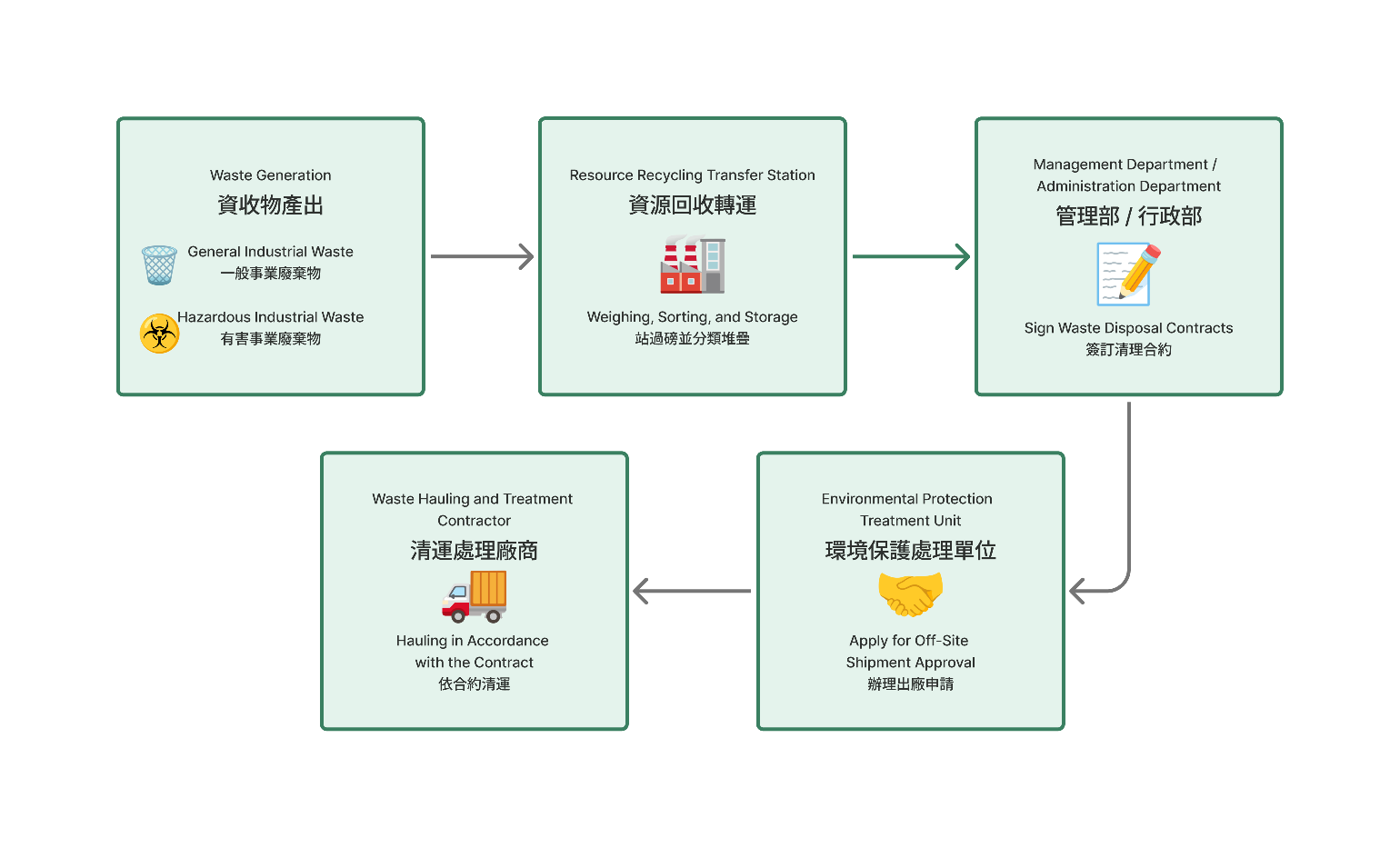
In terms of potential impacts, if waste is not properly sorted or is handled by unqualified organizations, it may cause environmental pollution or harm human health. In addition, failure to effectively recycle resources may result in resource waste and increased environmental burdens. In response to these risks, the Company has established corresponding management measures, including proper waste sorting and temporary storage management, the use of qualified removal and treatment organizations, tracking of the waste hauling process, and regular audits of treatment contractors, in order to ensure that the final destination of waste complies with relevant regulatory requirements.
At the same time, the responsible unit regularly reviews waste generation and treatment conditions, continuously tracks management performance, and dynamically adjusts management measures to reduce the potential impacts of waste on the internal and external environment and strengthen overall environmental risk control capabilities.
Analysis of Potential Impacts of Waste Generated from Operating Activities
| Category | Source | Type | Treatment Method | Potential Impact | Response Measures |
|---|---|---|---|---|---|
| General industrial waste | Routine office waste | General waste | Landfill, incineration | Cleaned up on a regular basis in accordance with government policy, with no potential impact on the broader environment. | Handled and treated by qualified removal and treatment organizations. |
| Recyclable waste | Recycling and reuse | ||||
| Manufacturing processes | Rotors, stators, impellers, and frames | Physical treatment, incineration, landfill | If third-party treatment organizations fail to dispose of entrusted industrial waste in accordance with the law, pollution or health hazards may be caused to the broader environment; therefore, proper oversight is required. | When removal and treatment are outsourced, personnel follow the transport vehicle to the treatment site to confirm that the waste entrusted by the Company is delivered to and handled at a legally authorized facility. | |
| Scrapped production offcuts | Physical treatment, incineration | ||||
| Raw material packaging | Vacuum trays and cartons | Recycling and reuse | Managed through reuse and recycling, with no potential impact on the broader environment. | Packaging materials are sorted and centrally stored to prevent improper disposal. | |
| Hazardous industrial waste | Manufacturing processes | Waste circuit boards and waste solutions | Physical treatment, incineration | If third-party treatment organizations fail to dispose of entrusted industrial waste in accordance with the law, pollution or health hazards may be caused to the broader environment; therefore, proper oversight is required. | When removal and treatment are outsourced, personnel follow the transport vehicle to the treatment site to confirm that the waste entrusted by the Company is delivered to and handled at a legally authorized facility. |
| Scrapped production offcuts | Physical treatment, incineration |
Waste Treatment Procedures
Roles and responsibilities
Treatment methods
Classification and management
Management of outsourced hauling and treatment
Data recording and reporting mechanism
Audit and oversight mechanism
Waste Treatment Process