










We use cookies to allow our website to function properly, personalize content and advertisements, provide social media features, and analyze traffic. We also share information about your use of our website with our social media, advertising, and analytics partners.
Annual performance
The Company has continued to demonstrate a strong commitment to environmental management and sustainable governance, responding to global climate action demands with tangible results. During the year, the Company conducted a comprehensive group-wide greenhouse gas inventory and obtained external third-party verification, ensuring data transparency and reliability, and laying a solid foundation for the formulation of subsequent carbon reduction strategies and performance tracking.
In terms of energy transition, the group-wide proportion of green electricity usage increased to 42.19%, with a total of 17.55 million kWh of renewable energy adopted, effectively reducing the Company’s operational carbon footprint and supporting the development of the renewable energy market. Water resource management also achieved measurable results: compared with the 2022 baseline year, total group-wide water withdrawal decreased by 46.76 million liters, representing a reduction of 15%, reflecting the Company’s continuous efforts to enhance process efficiency and water recycling and reuse. In addition, compared with the baseline year, group-wide Scope 1 and Scope 2 greenhouse gas emissions were reduced by 9,037 metric tons of CO₂-equivalent, a reduction of as much as 37%, demonstrating significant achievements through the adoption of energy-saving technologies, equipment improvements, and the use of green electricity.
The Company also continues to maintain IECQ QC 080000 certification, demonstrating high standards in hazardous substance management and the implementation of comprehensive controls across design, procurement, and manufacturing processes. Overall, through systematic management and continuous innovation, the Company is steadily advancing the reduction of its environmental footprint and taking more resilient steps toward sustainable operations.
42.19 %
Renewable electricity ratio
46.76 million liters
Water withdrawal reduction
9037 tCO₂e
Category 1, Category 2 greenhouse gas emission reduction
Responsible unit
The Company has set up a responsible unit to control, dispose of and report the business waste generated from the Company's operations, and disposes of waste in accordance with the local waste regulations of each site. The waste disposal methods are all implemented in accordance with local laws and regulations.
The waste management responsible departments of Sunon are:
-
Waste Classification: Each department
-
Waste Storage: Occupational Safety Team, Administration Department, Management Department of each factory
-
Waste Data Collection: Occupational Safety Team, Administration Department, Management Department of each factory
-
Waste Reporting: Occupational Safety Team, Management Department of each factory
-
Waste Treatment - Self-treatment: Each department
-
Waste Treatment - Outsourced Treatment: Occupational Safety Team, Administration Department, Management Department of each factory
The Company records the types, quantities and tracks the flow of hazardous business waste through paper forms, and measures the amount of waste generated by production capacity estimation and actual measurement. Hazardous business waste cannot be self-disposed in the factory due to technical or regulatory requirements, so it is entrusted to qualified external companies for transportation and disposal. For outsourced waste, after obtaining the documents issued by the external transportation company, the consistency with the measurement weight in the factory must be checked, and the tracking system in accordance with local government regulations must be followed to ensure that the transportation and disposal company disposes of the business waste according to the Company's requirements.
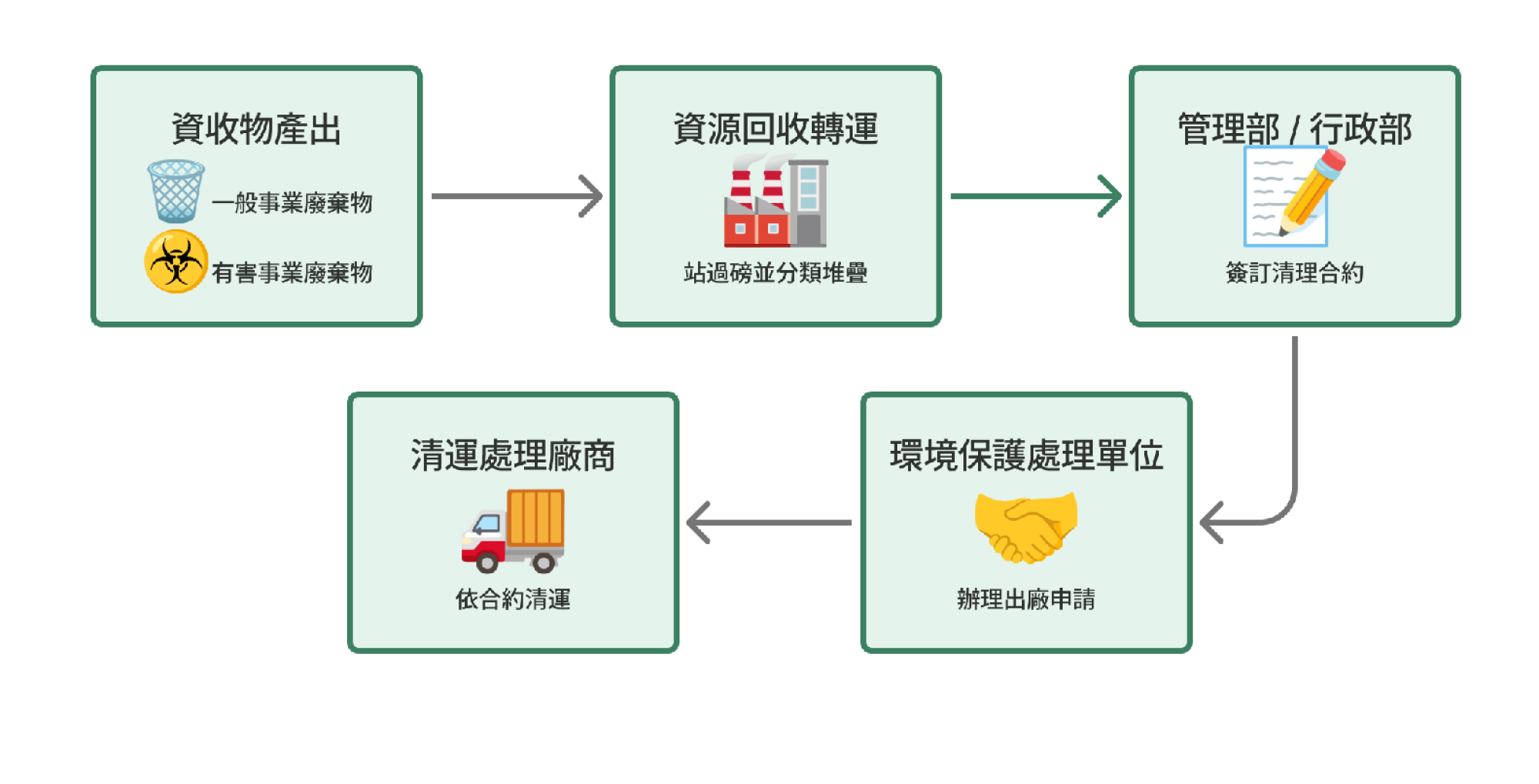
Other waste, such as employee domestic waste, is cleared and disposed of by qualified clearance and disposal agencies.
Sunon's Waste Management Strategy and Objectives
| Management Strategy | Base Year Index | Management Objectives | Improvement measures | ||
|---|---|---|---|---|---|
| Short-term | Mid-term | Long-term | |||
| Effective Waste Management and Disposal | 0.037 | Reduce Waste Generation Index by 0.5%. | Reduce Waste Generation Index by 1.9%. | Reduce Waste Generation Index by 7.4% |
|
Note 1: Definitions of short-, medium-, and long-term goals: Short-term refers to 2025, medium-term to 2030, and long-term to 2050.
Note 2: The base year is 2023. Waste Generation Index = Total weight of group-generated waste / Total gross weight of inventoried products.